

Adhkar Are Not Affirmations
On Understanding What You’re Actually Saying and Why It Matters

I keep seeing Muslims talk about their daily affirmations or their “morning practice” like adhkar are just the Islamic version of manifesting or positive self-talk. And really, I get it—there’s overlap in the structure. You repeat something. You say it consistently. You hope it shapes how you think and feel. But adhkar are not affirmations. And treating them like they are misses the entire point.
Affirmations are about convincing yourself of something. I am capable. I am enough. I deserve good things. You’re trying to override doubt, to build yourself up, to create confidence where there wasn’t any before. The foundation is you—your belief in yourself, your ability to reshape your thoughts through repetition.
Adhkar work differently. They’re not about building yourself up. They’re about recognizing who Allah is and where you actually stand in relation to Him. The foundation isn’t you. It’s Him. And that makes all the difference.
When you say Subhana Rabbiyal-Adheem in ruku’ for example, you’re not hyping yourself up. It may come off as reassuringif it’s in the facet of tawakkul and knowing Allah. But in this case, let’s assume it’s not. You’re typically saying: Glory to my Lord, the Magnificent. You’re declaring that He is beyond any flaw, any limitation, anything you could compare Him to. You’re small. He’s everything. And you know without a doubt this is true, and not manifestaional.
When you say Hasbunallah wa ni’mal Wakeel, you’re not trying to convince yourself everything will work out. You’re stating a fact that is clear as regards tawheed, which is that Allah is sufficient for us, and He’s the best one to manage our affairs. Whether the situation resolves the way you want or not, His handling of it is better than anything you could’ve done.
When you say La hawla wa la quwwata illa billah, you’re not building inner strength. You’re admitting you don’t have any strength on your own. Every bit of power you have is from Him. That’s not empowering in the self-help sense. It’s just honest. And that honesty is what actually changes you. It is what makes you reach the innerlings of your core and build up tawakkul (reliance on Allah).
Because here’s the thing: affirmations only work if you believe them. If you don’t genuinely think you’re capable or deserving or strong, repeating it might help over time, but the whole structure depends on you generating that belief from within. And when you fail, when circumstances crush you, when your confidence wavers—the affirmation collapses…because it was built on something fragile.
Adhkar, on the other hand, do not collapse. Because they’re not built on you. They’re built on who Allah is. And He doesn’t change based on how you’re feeling today. You can say Alhamdulillah when you’re grateful and everything’s going well. You can also say it when you’re struggling, when nothing makes sense, when you’re barely holding it together. Because Alhamdulillah—all praise is due to Allah—isn’t contingent on your circumstances. It’s a recognition that He’s still worthy of praise, that everything you have is still from Him, even when it doesn’t feel like enough. It is in fact proof that things could have been worse, and that you have it better. Or even to make you realize your own blessings, even in misery.
That’s different from telling yourself “I’m blessed” when you don’t feel blessed. One is you trying to create a feeling. The other is you anchoring yourself to a reality that exists whether you feel it or not.
And this is why understanding what you’re saying actually matters. You can recite Allahu Akbar a hundred times and if you don’t know what it means, it may have little to no effect on you. But when you pause and think about what you’re actually declaring—Allah is greater—greater than your fear, greater than your ambition, greater than the thing you’re obsessing over, greater than the outcome you’re desperate for—it does something to you.
It shrinks everything else down to size. It reminds you that nothing you’re facing is ultimate. That the thing keeping you up at night, the thing consuming your thoughts, the thing you think will make or break you—it’s not bigger than Him. And if it’s not bigger than Him, then it’s not as overwhelming as it feels.
Same with Astaghfirullah. If you’re just saying it because you’re supposed to, it becomes routine. But if you stop and think about what you’re doing—asking the Creator of everything, the One who doesn’t need you at all, to forgive you for the ways you’ve failed Him—and recognizing that He does, again and again, not because you earned it but because He is al-Ghafur, the Oft-Forgiving—that hits different.
It is humbling, and it’s not even in a performative, self-deprecating way. Just in a way that reminds you that you’re not the center. That your mistakes don’t define you as long as you keep turning back. That Allah’s mercy is bigger than whatever you did.
And when you say La ilaha illallah and actually sit with what that means—there is no god but Allah, nothing else is worth ultimate loyalty, ultimate hope, ultimate fear—you start to see how much of your life you’ve been giving to things that don’t deserve it. Career. Reputation. People’s approval. Outcomes you can’t control. Saying La ilaha illa Allah regularly doesn’t just remind you of tawheed as a concept. It trains you to actually live like it’s true. Like Allah is the only one whose judgment matters. Like everything else is secondary.
That’s what the adhkar are doing. They’re not just earning you reward—though they are. They’re not just protecting you—though they do. They’re training your mind to default to the truth. To return to Allah first, not as a last resort.
And that’s the part people miss when they treat adhkar like tools. Like spiritual techniques you pull out when you need something. Yes, the morning and evening adhkar protect you. Yes, certain du’as are answered in specific ways. Yes, there’s immense reward in making dhikr. But if your relationship with these words is purely transactional—I say this so I get that—you’re not engaging with what they’re actually meant to do.
Adhkar aren’t just about asking Allah for things. They’re about knowing Him. Every time you repeat His names, every time you declare His attributes, every time you affirm His oneness—you’re deepening your understanding of who He is. And the more you know Him, the more your trust in Him becomes reflexive. Natural. Unshakable.
That’s tawheed. And it goes beyond just believing Allah exists—every Muslim believes that. But believing He’s enough. That He alone deserves your full reliance. That everything else is secondary. That when you’re anxious, when you’re lost, when you don’t know what to do—He’s the first place you turn, not the last.
And you can’t build that just by thinking about it. You build it by saying it. Over and over. Until it stops being something you have to remind yourself of and starts being the language your heart speaks.
When my anxiety spikes, Hasbunallah wa ni’mal Wakeel comes to mind before the spiral even starts. Not because I’m some elevated spiritual person. Just because I’ve said it enough times that my brain goes there first now. That’s what repetition does. It creates pathways. And when the thing you’re repeating is true—when it reflects reality, not just what you hope is true—those pathways lead somewhere solid. Affirmations try to create reality through belief. Adhkar align you with a reality that already exists. And that’s the difference.
So if you’ve been treating adhkar like affirmations, like tools to boost your mood or fix your mindset, start to think about what you’re actually saying. Think about who you’re saying it to. These aren’t words you came up with to make yourself feel better. These are words the Prophet (SAW) taught you. Words the muslims have been saying for over a thousand years. Words that reflect the nature of reality itself. They’re not here to serve your agenda. They’re here to recalibrate your entire frame.
Again, stop asking what the adhkar can do for you and start asking what they’re teaching you about Allah. Because once you actually understand that, once you believe what you’re saying, the transformation isn’t something you have to work for. It just happens. Because truth, when you align yourself with it, doesn’t leave you the same.
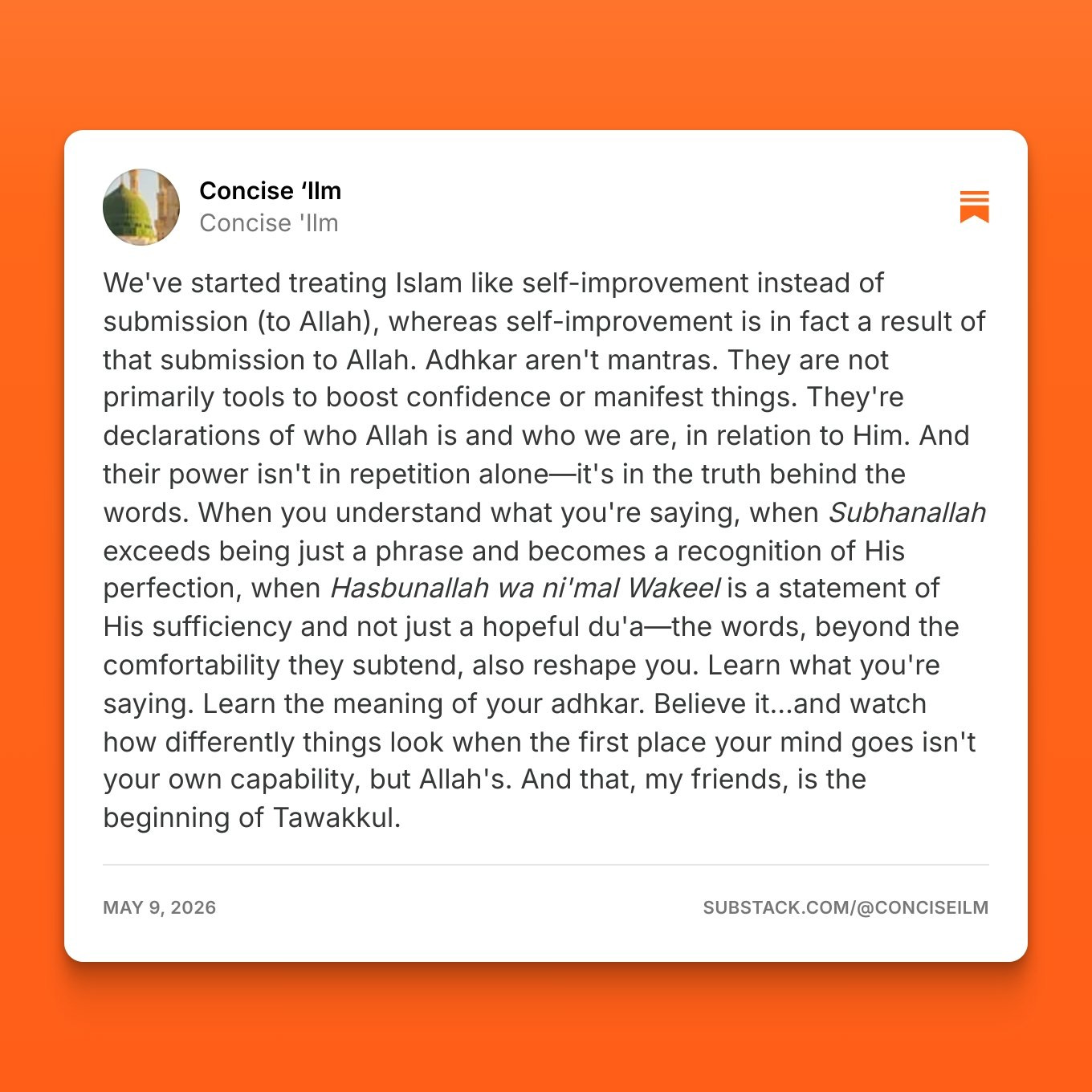
Closing Reflection
This week, Dear Reader, pay attention to the adhkar you say. Do you know what they mean? Do you believe them when you say them? Or are they just sounds, words you hope will protect you without actually anchoring you? The beauty and strength of adhkar isn’t in the repetition alone. It’s in the belief behind them. So learn what you’re saying. Reflect on it. Let it settle. And see how the world looks when what you reach for first isn’t your own strength, but Allah’s.
-this is beautiful; “Adhkar work differently. They’re not about building yourself up. They’re about recognizing who Allah is and where you actually stand in relation to Him. The foundation isn’t you. It’s Him. And that makes all the difference.”